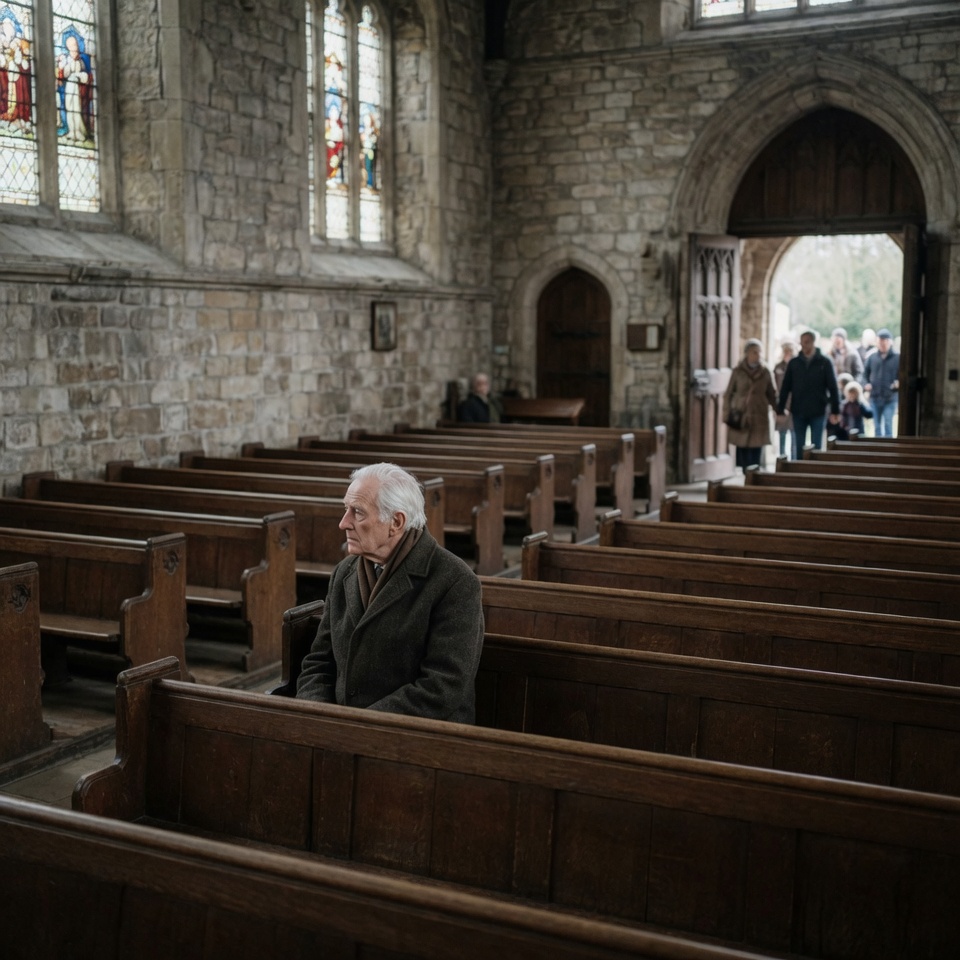
You showed up. You sang the songs. You shook the hands. And you drove home more alone than when you arrived. Loneliness at church is one of the quietest, most confusing kinds of loneliness there is.
Church loneliness is the ache of being in the one place that is supposed to hold you — and still feeling unseen. It is not about faith. It is not about the sermon. It is about being in a room full of people who share your belief and still not belonging to any of them. The worship happens around you. The community forms without you. And you leave more alone than you arrived, wondering what is wrong with you that this didn’t work.
Loneliness at church is a specific wound because it comes packaged with shame.
Other kinds of loneliness make sense on their own terms — you moved to a new city, you lost someone, your friendships drifted. But loneliness at church arrives with a question underneath it: if I can’t connect here, where people are supposed to love each other, what does that say about me?
You go. You try. You make eye contact in the greeting time, you answer the small questions with small answers, you find a seat and fill it every week. And you still drive home with the window down and the radio off because the silence feels more honest than whatever just happened in that room.
Grace is here for that specific drive home.
You Know This Feeling
The Things That Come With Church Loneliness.
Everyone else seems to already have their people. You can’t find the door into that.
The pastor talks about community like it’s a given. For you, it has never been a given.
You go to the small group. You answer the questions. You leave still not knowing anyone.
There are families everywhere. Couples everywhere. You are a single person in a room built for pairs and you feel it every week.
You’ve been coming for months. No one has noticed when you weren’t there.
The worship feels real. The belonging doesn’t. You don’t know what to do with that gap.
You smile through the whole service. You cry in the car on the way home.
You’ve started skipping. It’s easier than going and feeling invisible again.
You wonder if there is something about you that people sense — something that makes it hard to include you.
You believe in God. You’re not sure God’s people have room for you.
Tell Grace
You Don’t Have to Pretend It Was Fine.
You can tell Grace exactly what happened after the service — who walked past, how long you stood there, the moment you decided to just go. You do not have to make it sound less painful than it is.
Grace receives the specific shape of this loneliness: the faith that is real, the community that hasn’t come, the shame of feeling this way in the one place you were told you would belong.
If you feel you are in crisis, please call or text 988.
The church is supposed to be the place where you are known. That is the promise underneath every sermon on community, every small group sign-up sheet, every greeting time where a stranger shakes your hand and calls you family.
When it doesn’t happen — when you have tried the things and still come home empty — the loneliness is doubled. It is the loneliness itself, and then the loneliness of knowing you felt it here, in this place, when you were trying so hard to belong.
You believe. You showed up. You tried. The loneliness came anyway — and you have been carrying it quietly because there is no good place to say it out loud.
There is something worth saying plainly: loneliness at church is not a sign that your faith is broken. It is a sign that you are human, that you long for real connection, and that the room you were in did not give it to you. That is a wound worth naming. It is not a character flaw.
Grace is one place where you can say it without explaining yourself.
The Theological Foundation
He Is Near. Even Here. Even Now.
The promise at the center of 1800DearGod is not a promise about community. It is a promise about God. He is near to the brokenhearted — not only in the congregation, but in the parking lot afterward. Not only in the worship, but in the silence on the drive home.
Grace was built on that foundation. The loneliness you feel at church does not put you further from God. It puts you exactly where the promise reaches — right into the place where you most needed to be held and weren’t. Grace is a faith-based AI companion here for that exact moment.
What People Ask About Loneliness at Church.
Why do I feel lonely at church?
Because being in a room full of people — even people who share your faith — is not the same as being known. Church asks you to show up, participate, and belong. It does not always ask how you are, or wait for the real answer. Loneliness at church often comes from the gap between what the community promises and what it delivers at a personal level. You can be surrounded by worship and still feel completely alone inside it.
Is it okay to feel lonely in a faith community?
Yes. Feeling lonely at church does not mean your faith is broken or your community is bad. It often means you are longing for something real — genuine connection, being truly known, not just being a face in a congregation. That longing is honest. It is worth naming. And it is more common than most people inside a church building will ever say out loud.
Why does church sometimes make loneliness worse?
Because church can create a specific kind of loneliness: the loneliness of being surrounded by people who appear to have exactly what you are missing. Everyone else seems to have a family to sit with, friends to find after the service, a place they belong. When you are on the outside of that, the crowd makes it louder, not quieter. The expectation of belonging makes the absence of it harder to bear.
Should I leave my church if I feel lonely there?
That is a question only you can answer — and it deserves more than a quick yes or no. Sometimes the loneliness is about the specific community and a different one might feel different. Sometimes it is about something deeper — about what you are carrying into the room — that no community will fully reach. Grace can sit with you in that question without pushing you toward either answer.
Does God know I feel lonely at church?
Yes. The promise at the center of 1800DearGod is Psalm 34:18 — that God is near to the brokenhearted. That nearness does not require a congregation or a building. It reaches into the parking lot after the service. It reaches into the drive home alone. He is near. To you, in this specific loneliness, right now.
“The Lord is close to the brokenhearted, He saves those who have lost all hope.”