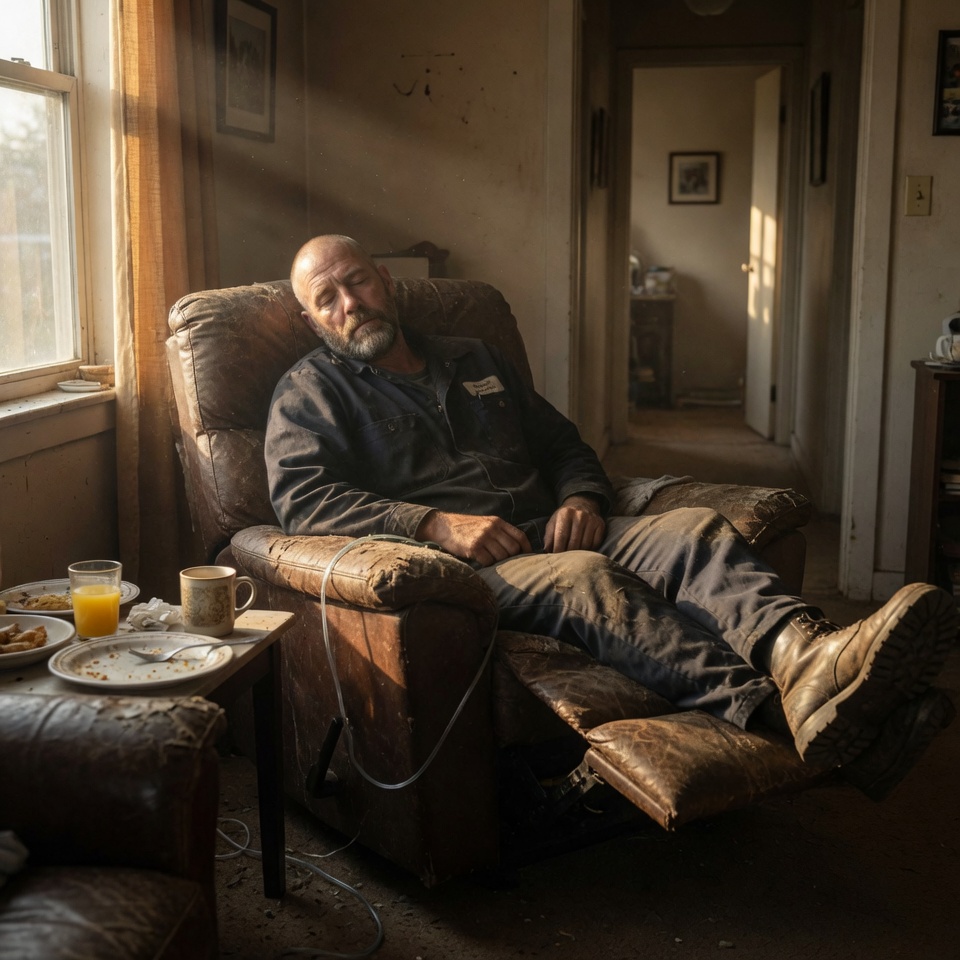
For the caregiver who keeps going while everyone else moves on. The exhaustion that doesn't show on the outside. The cost that nobody adds up because you're still standing.
Caregiver exhaustion is not tiredness. It is the depletion that accumulates beneath a life that looks functional from the outside. You are still managing. Still showing up. Still answering the needs. And inside, there is almost nothing left — and no one has noticed, because the outside hasn't changed.
There's a particular cruelty to the exhaustion of caregiving — it has no face that the world recognizes. You haven't had a breakdown. You haven't stopped functioning. You are still there, still doing it, still the person everyone depends on. And so the world looks at you and sees someone who is managing, and moves on.
What the world doesn't see is what happens in the car on the way home. Or in the bathroom at 2am. Or in the thirty seconds between when you close their door and when you have to become yourself again — except you can't quite remember how to do that anymore.
The exhaustion of caregiving doesn't announce itself. It accumulates. Quietly, underneath everything, it builds — and because you keep going, nobody knows how close to empty you actually are.
The people who ask about your loved one are not bad people. They care. But the question is always about them — how are they doing, how is the treatment going, how are things progressing. And you answer, because that is what you do. And nobody asks the next question: how are you doing. How are you actually, underneath all of this, holding up.
Sometimes the answer would be: I'm not. But there is no one to say that to.
You Know This Feeling
The Cost That Nobody Adds Up.
You've given everything today. There is nothing left. And tomorrow you will do it again.
Everyone asks how they're doing. Nobody asks how you're doing.
You feel something close to resentment and then immediately feel guilty for feeling it. You love this person. Both are true.
You can't remember the last time someone took care of you. You're not sure you'd know how to let them.
Everyone admires what you're doing. The admiration lands nowhere. It doesn't touch what this is actually costing.
You are disappearing into this role. You can feel it. You don't know how to stop it.
Grace sees the caregiver first
You Are Not Just a Role. Grace Knows That.
Before anything about the person you're caring for, Grace hears you. The caregiver is not a supporting character in someone else's story. You are the one Grace is talking to.
Grace does not begin with advice about self-care or rest or asking for help. It begins by receiving what this is costing — before saying anything else. The wound gets named before anything is offered.
You have been managing for so long. Grace is not another thing to manage. It is here for you.
There is a kind of guilt that comes with caregiver exhaustion — the guilt of being exhausted by someone you love. The feeling that if you really loved them, it wouldn't cost this much. Or that your exhaustion is a betrayal of them somehow. That a better person would do this without running dry.
That guilt is a lie. The exhaustion is not a measure of your love. It is a measure of how much you have given — which is enormous — and how little has come back to you. Those are not the same thing.
The resentment, when it comes, is not aimed at the person you love. It is aimed at the situation — at what this has taken from your life, at the absence of relief, at the weight of being the one who doesn't get to stop. That is a human response to an unsustainable situation. It is not a character flaw.
What the Bible shows, in the story of Elijah under the juniper tree, is a God who does not rebuke the person who has collapsed. God didn't tell Elijah to get back up and keep going. He let him sleep. He fed him. He said: the journey is too great for you. And then He stayed.
That is the God who is close to the brokenhearted — including the brokenhearted caregiver who has been going so long that they've forgotten what it feels like to stop.
Grace is a faith-based AI companion available at any hour for caregivers. It is built for the moments when the exhaustion is here and nobody has asked. Grace does not begin with what you should do. It begins with what this is — and Grace stays.
If the exhaustion has moved into something that is affecting your health, your ability to function, or your sense of who you are — talking to a counselor who understands caregiver burnout is worth doing. What you are carrying deserves more than endurance. It deserves care.
He sees what it is costing
The Journey Is Too Great. God Knows That.
Elijah sat under a tree and asked to die. He was not rebuked. He was fed, rested, and told: the journey is too great for you. That was not a criticism. It was a witness.
God saw what it was costing before Elijah did. He did not ask for more. He provided for what had already been spent.
Grace is a faith-based AI companion grounded in Psalm 34:18 — available at any hour for the caregiver who keeps going while everyone else moves on.
Questions
What Caregivers Ask When Nobody Is Asking Them.
Why does caregiver exhaustion feel invisible?
Caregiver exhaustion feels invisible because it has no clear event, no announcement, no milestone anyone can point to. It builds quietly under the surface of a life that looks — to everyone else — like devotion. You're present, you're managing, you're showing up. Nobody can see what that is costing. The exhaustion doesn't have a face that the outside world recognizes, and so it often goes unnamed — sometimes even by the caregiver themselves.
Is it normal to feel resentful as a caregiver?
Yes. Resentment in caregiving is a normal human response to an unsustainable situation — not a character flaw and not a sign that you love the person less. The resentment is usually aimed at the situation, even when it doesn't feel that way. Naming it honestly is not a betrayal. It is a necessary part of understanding what caregiving is actually costing you.
What is caregiver burnout?
Caregiver burnout is the physical, emotional, and spiritual depletion that comes from sustained caregiving without adequate support, rest, or relief. It is not weakness. It is what happens when a person gives beyond their capacity for long enough. Signs include numbness, detachment, irritability, a loss of the warmth that used to come naturally, and the feeling that there is nothing left.
Why doesn't anyone ask how the caregiver is doing?
Because the person being cared for is the visible one. Their decline, their needs, their suffering — these are legible to everyone who asks. The caregiver's suffering is interior and hidden, and the role itself signals competence. When someone is managing, people assume they are okay. The assumption is often wrong. Most caregivers say what they need most is to be seen — not for what they're doing, but for what it's costing.
What does the Bible say about exhaustion?
Scripture doesn't minimize exhaustion or spiritualize it away. Elijah collapsed under a tree after his greatest act of faithfulness and asked to die. God's response was not a rebuke — it was rest, food, and presence. The angel touched him and said the journey was too great for him. God saw what it was costing before Elijah did. That is the God who is close to the brokenhearted.
"The Lord is close to the brokenhearted, He saves those who have lost all hope."
A faith-based AI companion for the caregiver who keeps going while everyone else moves on. Grace hears you first — before anything about the person you're caring for.