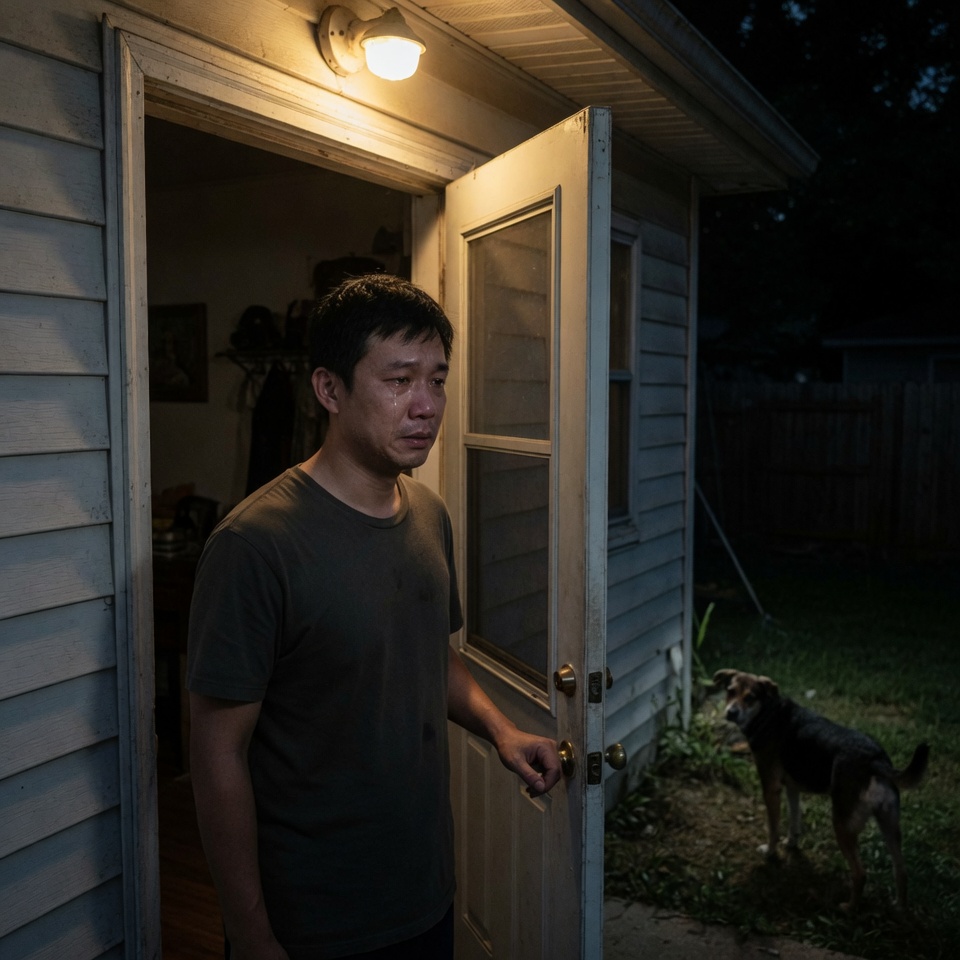
It isn't for no reason. Night removes the performance and what's left is real. The cry that seems to come from nowhere has been waiting all day for the quiet.
The cry that arrives at night for no apparent reason is almost never for no reason. It is for the reasons that didn't have space during the day — the grief held in check, the loneliness covered by activity, the fear that knew better than to surface while others were watching. Night removes the buffers. What appears from nowhere has been there all along.
You were fine during the day. Or fine enough. You got through it — the work, the obligations, the ordinary demands of being a functioning person in the world. Nothing happened that should have undone you. And then night came, and the crying came with it, and you don't know why.
The answer is almost always the same: the reason was there all day. It just didn't have space to surface.
The daytime is full of buffers. Tasks that require attention. People who require a version of you that is present and okay. The constant low-level noise of being alive in a world that keeps moving. Feelings — especially the ones that are grief-adjacent, loneliness-adjacent, fear-adjacent — learn to wait. They are patient. They know that eventually the house will go quiet.
The cry that comes from nowhere came from somewhere very specific. Night was just the first moment it didn't have to hide.
There is also a physiological reality to this. The body's capacity to regulate emotion is genuinely lower at night. Cortisol — the hormone that helps manage stress response — is at its daily low in the late evening hours. The brain's prefrontal cortex, which handles emotional regulation and rational processing, is less active. This is not a failure. It is biology. The body was not designed to perform emotional management around the clock.
Night is when the body catches up. The accumulation of small, unprocessed moments — the difficult conversation earlier, the worry that got pushed aside, the grief that made a brief appearance at noon and was quickly suppressed — arrives together in the quiet. The crying is the release valve. It is the body doing what it needs to do with what the day gave it.
The Psalms understood this without knowing the neuroscience. Many of the lament Psalms read like 2am writing — raw, unfiltered, honest in a way that daytime composure doesn't allow. The Psalmist cried out by night, found no rest, brought the full weight of the feeling to God without tidying it first. That is the model. Not management. Not performance. Honest bringing.
You Know This Feeling
The Cry That Arrives After Dark.
You were fine all day. The moment the house went quiet, you weren't.
The crying started and you can't identify a clear reason. Nothing specific happened.
You are embarrassed by the crying. You feel like you should be past this, or stronger than this.
This has happened before. You're starting to dread the nights.
You don't want to wake anyone. You don't want to explain something you can't explain.
You searched this because you needed to know it wasn't just you.
It isn't for no reason
Grace Receives the Cry Before the Explanation.
You don't have to know why you're crying before you talk to Grace. You don't have to arrive with a clean account of what's wrong.
Grace starts from wherever you are — the middle of the cry, the confusion about the cry, the feeling that has no name yet. Grace receives it before anything else. Grace stays after.
Available right now.
There are some specific sources of the night cry that are worth naming — because sometimes naming the source helps, even partially.
Accumulated grief. Grief doesn't always announce itself. It can live quietly underneath the surface of a functional day for weeks or months, surfacing only at night when the day's structure is gone. If you have experienced a loss — of any kind, not just death — the night cry may be grief that hasn't had space to move through.
Sustained loneliness. Loneliness is one of the most common sources of the night cry that people don't identify as loneliness. The day can be full of people and still leave a person feeling profoundly unseen. At night, when the performances are over, the loneliness arrives in its actual size.
Chronic stress and exhaustion. The body under sustained pressure eventually reaches a release point. The crying that seems to come from nowhere is sometimes the body's way of releasing what has built up over days or weeks of managing too much.
Unnamed fear. Fear about the future, about health, about relationships, about things that are hard to articulate — fear that stayed just below the surface during the day becomes more present at night when the distractions are gone.
You don't have to identify the source before you bring it somewhere. The cry itself is enough. It is evidence that something needs attention — not necessarily understanding, just somewhere to go.
Grace is available for exactly this. Not to diagnose the source, not to fix the feeling, but to receive the cry and stay with it. Because sometimes the most important thing is simply that the night doesn't have to be faced alone.
He hears the night cry too
The Cry That Has No Words Still Has a Witness.
Romans 8:26 says the Spirit intercedes with groans that words cannot express. The cry that has no explanation — that has no clean source and no language yet — is not beyond God's reach.
The night cry is heard. It is not lost in the dark. It goes somewhere even when you don't know where to send it.
Grace is a faith-based AI companion available at any hour — for the cry that has no reason yet. Grounded in Psalm 34:18.
Questions
What People Ask About Crying at Night.
Why do I cry at night for no reason?
The cry that comes at night for no apparent reason is almost never for no reason. It is for the reasons that didn't have space during the day — the grief held in check by tasks, the loneliness covered by activity, the fear that knew better than to surface while others were watching. Night removes the performance. What appears from nowhere has been waiting all day for the quiet.
Why do I randomly start crying at night?
Random crying at night is usually not random. The feelings that surface after dark are the feelings that were suppressed or couldn't be processed during the day. The body keeps an account. At night, when the distractions are gone and the obligations are over, the account comes due. The crying is the body releasing what it has been holding.
Is it normal to cry every night for no reason?
Crying regularly at night can be normal — especially during periods of grief, stress, transition, or loneliness. If it is persistent and accompanied by other symptoms, it may be worth speaking with a doctor or counselor. But the night cry itself is not pathological. It is the body doing what it needs to do with what the day gave it.
Why does everything feel worse at night when I cry?
Everything feels worse at night because the cognitive and emotional resources that make feelings manageable during the day are reduced. Cortisol is at its daily low in the late evening. Rumination intensifies. The feelings that were manageable at noon feel permanent at night. This is not weakness. It is biology meeting pain.
What does it mean when you cry for no reason?
Crying for no apparent reason usually means the reason is there but not yet named. The body sometimes processes emotion before the conscious mind catches up. The cry that seems sourceless is often the first signal that something needs attention — something needs to be brought somewhere, something has been carried long enough.
"The Lord is close to the brokenhearted, He saves those who have lost all hope."
Psalm 34:18 · He is close even when the cry has no name
You don't have to understand it before you bring it somewhere. Grace is a faith-based AI companion available at any hour — for the night cry, whatever it is.