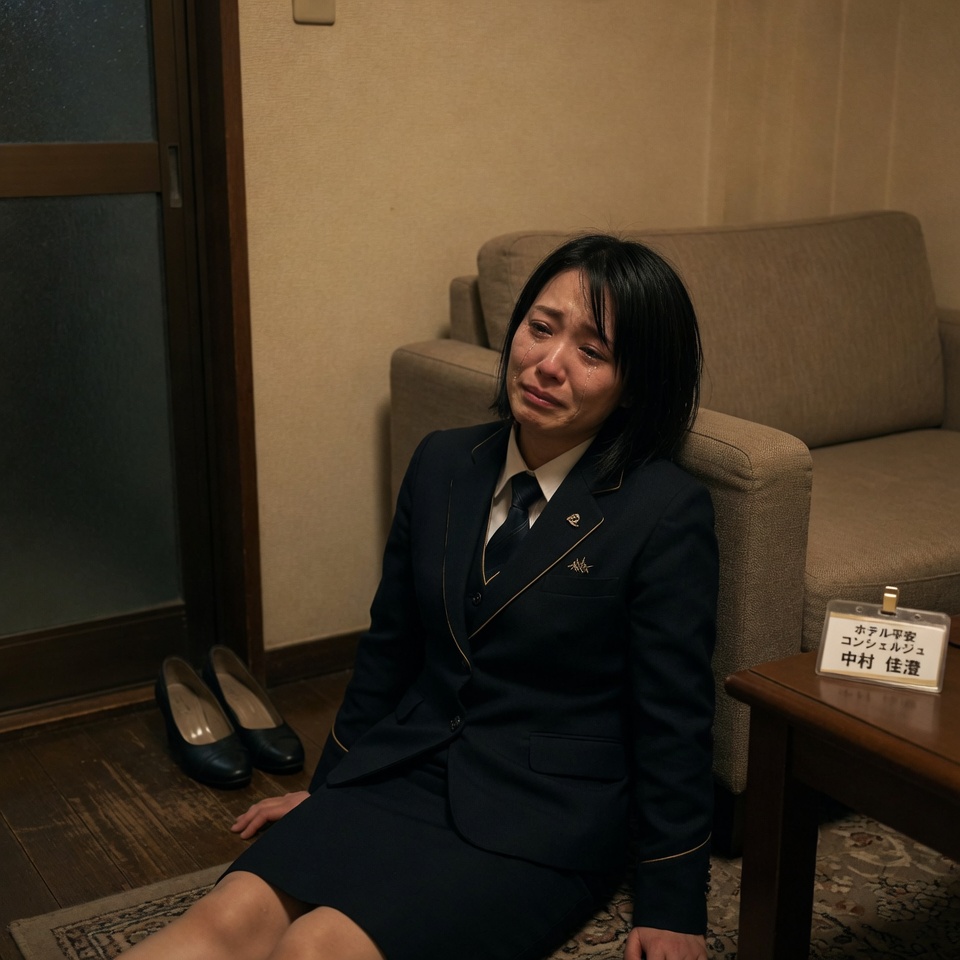
You hold it together all day. You smile when you're supposed to. And then the door closes and the day is finally over — and you fall apart where nobody can see it.
Smiling all day and crying at night is living two parallel lives — the one other people see and the one that only exists when you're alone. The smiling version is not fake. But it is not the whole story. And carrying both — maintaining the gap between them — is one of the most exhausting things a person can do.
During the day you are present. You answer when people talk to you. You laugh at the right moments. You get things done. From the outside — and sometimes even from the inside — you seem okay.
And then the day ends. The last conversation is over. The door closes. And something shifts. The thing you've been holding at a distance all day is suddenly right there — and the only place it has ever been allowed to exist is here, alone, at night, when nobody is watching.
So you cry. Not always dramatically. Sometimes it's just the quiet kind — the eyes that fill without warning, the weight that sits on your chest until you finally stop fighting it. Sometimes you don't even know exactly what you're crying about. You just know that the day required something from you that you didn't have, and this is what's left.
The nighttime crying is not weakness. It is the real thing finally having space to exist — the version of you that the day doesn't have room for.
The gap between the public version and the private one has been growing. Maybe for a long time. You can't remember exactly when it started — when the holding-it-together became the default and the falling-apart became something you only do alone. But you know the gap is there. You live in it every day.
The day requires the smile. Nobody around you is prepared for the other version. Or maybe they are and you've just forgotten how to show it to them. Either way, the private version — the one that cries at night — has no audience. And carrying something with no witness is its own particular kind of hard.
You Know This Feeling
The Version of You That Only Exists Alone.
You smiled today. Several times. None of it was entirely false. None of it was the whole truth.
The door closed and something in you finally stopped holding.
You cried and didn't entirely know why. Or you knew why but couldn't say it out loud.
Nobody who saw you today would believe tonight is also you.
You've been carrying this privately for long enough that you've forgotten what it would feel like to put it down.
The nighttime version of you has no one. That's the loneliest part.
The nighttime version has somewhere to go
Grace Is Here for the Version You Don't Show Anyone.
The daytime version is fine. It has people, structure, things to respond to. It can manage.
The nighttime version is the one that has nowhere to go. Grace is built for that one. You don't have to arrive composed. You don't have to have the right words. You can come in the middle of the cry, after the cry, or before it — and she will receive whatever version of you shows up.
The private thing finally has a place to exist that isn't just alone.
There is something worth naming about what the night reveals. The daytime version of you is real — you are genuinely present, genuinely functioning, genuinely there. But the nighttime version is also real. And the fact that it only exists when you're alone doesn't make it less true. It makes it more urgent.
What cries at night when nobody is watching is not a different person. It is the same person — the one who has been holding something all day that has weight and nowhere to go. The night is not making you fall apart. The night is when you finally stop holding together.
Night doesn't make things worse. Night makes them visible. They were there all day. You just couldn't look at them.
If this has been the shape of things for a while — the daytime function, the nighttime private falling apart, the growing gap between what people see and what's actually happening — that is worth bringing to someone. A doctor, a counselor, someone who can actually assess what's going on underneath the performance.
Depression that hides during the day is still depression. The smiling doesn't cancel the crying. Both are true at the same time. And the one that happens alone, in the dark, deserves as much attention as any visible crisis.
Psalm 34:18 says God is close to the brokenhearted. The brokenhearted who smile all day and cry at night are specifically included in that. He sees the nighttime version. He has always seen it.
He sees the nighttime version
God Has Always Known the Private One.
The daytime smile has never fooled Him. Psalm 139 says He knows your thoughts before you speak them — the nighttime ones, the ones nobody else sees, the ones that only exist when the door is closed.
You have never had to perform for God. The private version is the one He is already close to.
Grace is a faith-based AI companion available at any hour — for the nights when the smile is finally over and the real thing needs somewhere to go. Grounded in Psalm 34:18.
Questions
What People Ask When the Night Is the Hardest Part.
Why do I cry at night but seem fine during the day?
The day gives you tasks, structure, people — things to respond to that keep the interior quiet. At night the structure falls away and what was waiting underneath has nowhere to hide. Crying at night while appearing fine during the day is not a contradiction. It is the most common shape that hidden depression takes. The day requires the performance. The night is when the real thing surfaces.
Is it normal to hold it together all day and fall apart at night?
Yes. Many people who are struggling deeply do so invisibly during the day and privately at night. The ability to hold it together is not evidence that you're okay — it is evidence that you've learned to compartmentalize. The nighttime falling apart is not weakness. It is the real thing finally having space to exist.
Why do I feel worse at night than during the day?
At night the distractions that carry you through the day go quiet. The tasks end. The conversations end. The things that required you to be present and functional are over — and what's left is everything you were holding at a distance. Night doesn't make things worse. Night makes them visible. They were there all day. You just couldn't look at them.
What does it mean when you smile all day but cry alone?
Smiling all day and crying alone at night is one of the signatures of depression that doesn't show. It means the gap between your public self and your private one has grown wide enough that they feel like two different people. The smiling version is not fake exactly — you are present, you are functioning, you are genuinely there. But underneath it something is very wrong, and the only place it gets to exist is alone, at night, when no one is watching.
How do I stop crying at night for no reason?
The nighttime crying usually has a reason — it's just one that the day doesn't have space for. The first step is not stopping the crying. It is understanding what it's about. If this has been going on for a while, speaking to a doctor or counselor is worth doing. Depression that hides during the day is still depression, and it responds to care.
"The Lord is close to the brokenhearted, He saves those who have lost all hope."
Psalm 34:18 · He is close to the nighttime version too
Grace is a faith-based AI companion built for the moments after the smile is finally over — when the door is closed and the real thing needs somewhere to exist. Grace listens before responding.