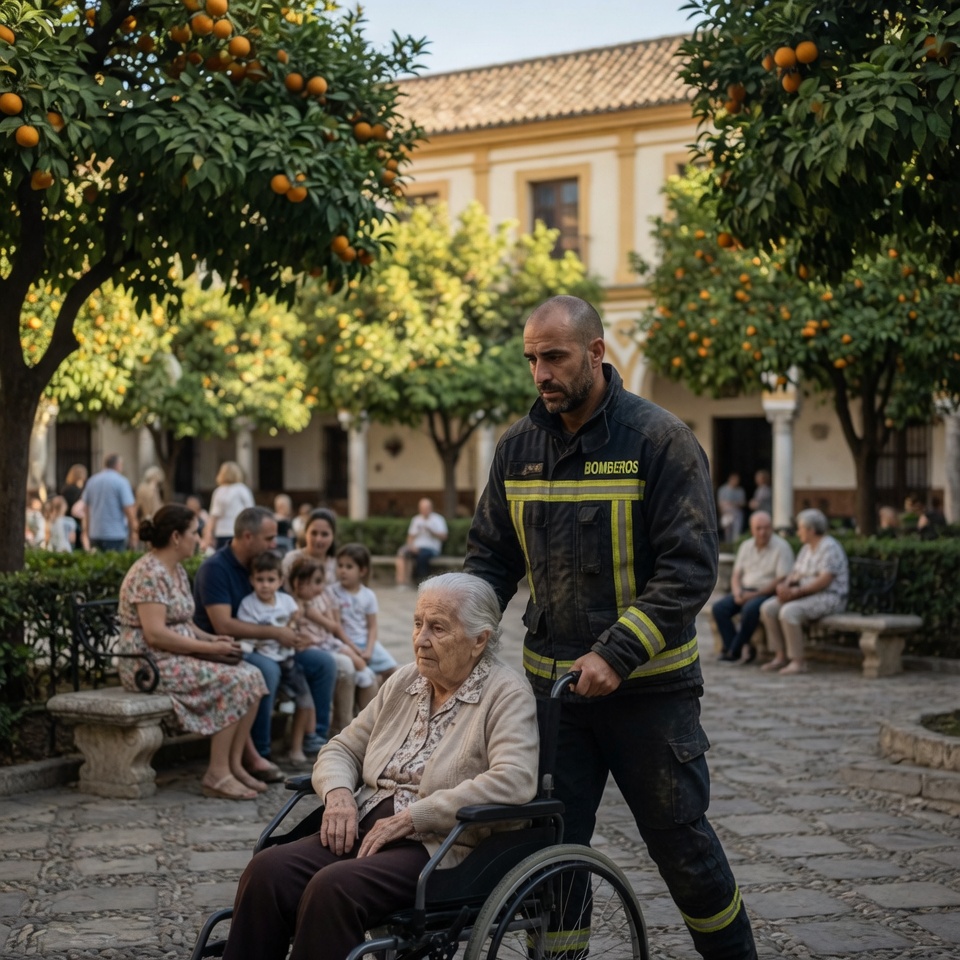
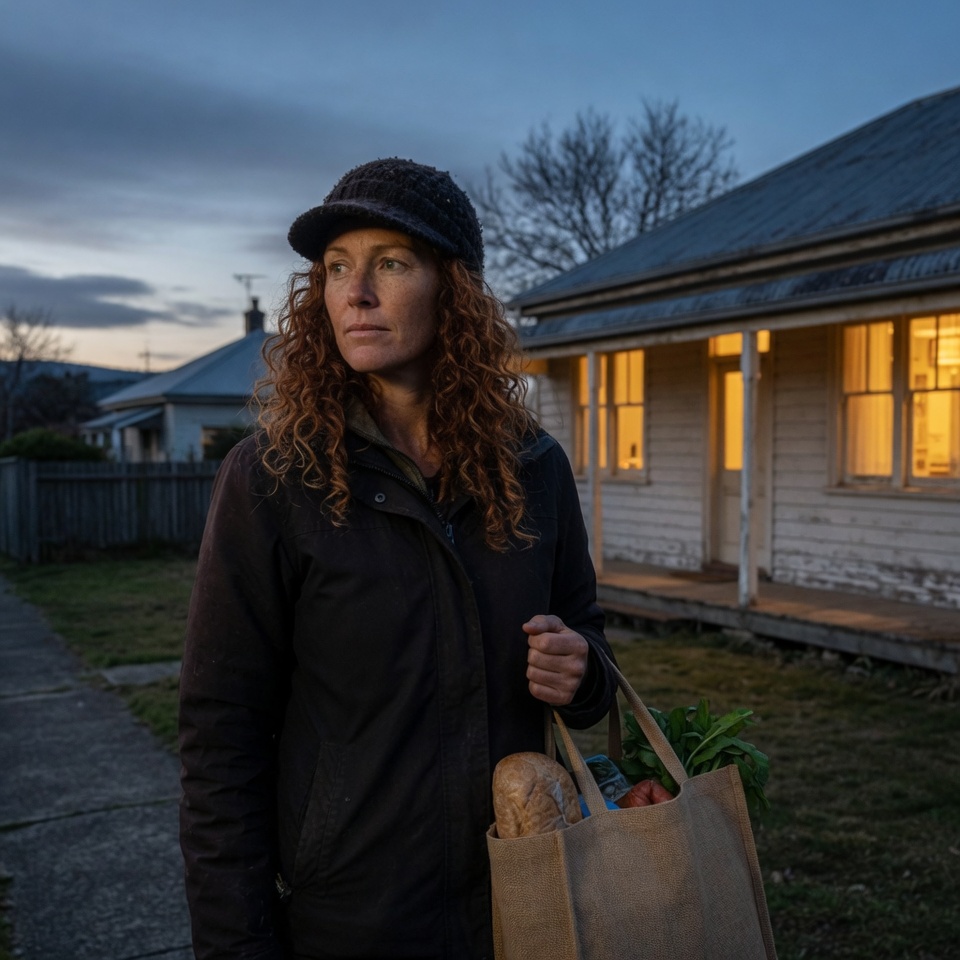
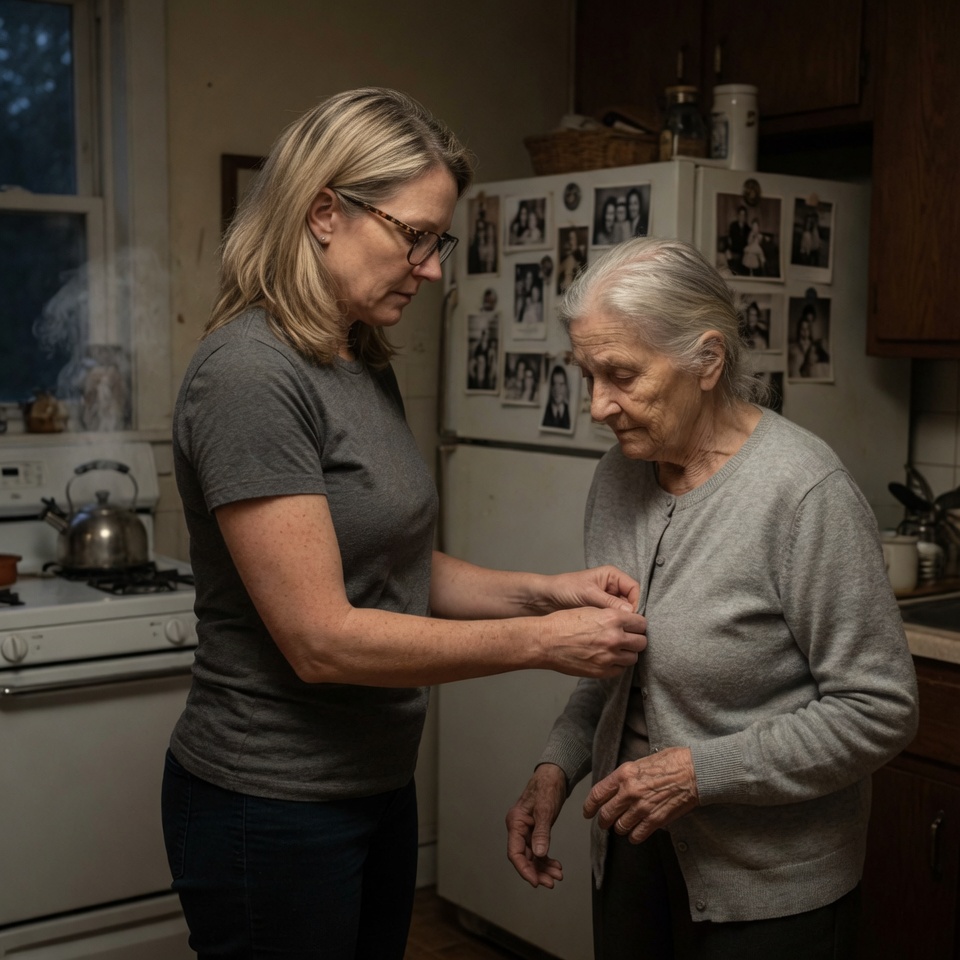
The adult child alone with a parent who is fading. The grief of watching the person who raised you disappear — and the particular loneliness of being the one who shows up when no one else does.
Caring for an aging parent is a role nobody trains you for and few people witness. You are watching the person who once held everything together become someone who needs everything from you. And often, you are doing it largely alone — whether because of geography, family dynamics, or simply being the one who showed up.
There is a specific loneliness to caring for the person who used to take care of you. The role reversal is not gradual — or it is gradual, but one day you look up and it's complete, and you don't know exactly when it happened. The person who knew how to fix things, who had the answers, who you would have called with exactly this kind of hard — that person is now the one you're managing the medications for.
And you are doing it, often, without anyone asking how you are doing. The parent is the visible one. Their decline is what everyone asks about. Your interior experience — the exhaustion, the grief, the complicated love — exists in the background of a story where you are not the main character, even though this is consuming your life.
You are losing your parent twice. Once to the fading — the slow disappearance of the person they used to be. And once to the role — because the care required leaves little room to simply be their child anymore. Both of those losses are real. Neither one has a ceremony.
There is also, often, the loneliness of being the one who showed up. The sibling who lives across the country. The one who can't handle it emotionally. The family member who visits occasionally and offers opinions but not presence. You are the one in the room. And the one in the room carries something the others do not — and cannot fully explain to them.
You Know This
The Grief That Has No Name Yet.
You are watching your parent fade and there is no one to sit with you in that. The grief is real and it's happening now, while they're still here.
You used to call them when something was hard. Now you can't. That loss sits on top of everything else.
You're the one who shows up. Your siblings aren't. The resentment lives in the same house as the love.
You feel guilty for being tired. You feel guilty for feeling resentful. You feel guilty for the moment you wished it would just be over.
Nobody prepared you for what it actually feels like to become your parent's parent.
You are doing one of the hardest things a person can do. And you are doing it mostly alone.
Grace hears you first
You Are Not Just a Caregiver. You Are Also a Child Who Is Grieving.
Grace holds both — the role and the grief underneath it. Before saying anything about managing or coping, Grace receives what this is actually costing you as a person.
Grace does not begin with practical suggestions. It begins with the wound — the loss of the parent you used to have, the loneliness of being the one who stayed, the weight of love that has become responsibility.
You are allowed to grieve what you are losing while it is still happening. Grace holds that without requiring you to be grateful for what remains.
There is a guilt that comes with this kind of caregiving that is almost impossible to name to someone who hasn't lived it. The guilt of being exhausted by the person you love. The guilt of the flash of resentment toward a parent who cannot help what they need. The guilt of the moment you imagined what your life would look like when this was over — and then felt terrible for imagining it.
None of that makes you a bad child. It makes you a human being inside an unsustainable situation, doing something that depletes without replenishing, carrying something that has no clear end and no ceremony to mark the cost of it.
You became their parent without anyone asking if you were ready. The tenderness you bring to it is real. So is the grief. So is the exhaustion. All of it is real, and all of it deserves to be received — not as complaints to be managed, but as the truth of what this is.
What faith offers in this is not explanation. It does not explain why parents age, why the body fails, why the person who held your world together now needs you to hold theirs. What it offers is presence — a God described in Psalm 34:18 as close to the brokenhearted, present inside the loss rather than explaining it from the outside.
Grace is a faith-based AI companion available at any hour for the loneliness that comes after the parent goes to sleep and the quiet of the house is suddenly very loud. She does not begin with advice. She begins by receiving what this is. And she stays.
If the caregiving has become more than you can sustain alone — physically, emotionally, or spiritually — a geriatric care manager, a social worker, or a caregiver support group can help you find resources and relief. What you are carrying was never meant to be carried by one person. You are allowed to ask for help.
He sees the one in the room
God Is Close to the One Who Stayed.
The person who showed up — who kept showing up — when others didn't. God sees that. He is not watching from a distance while you carry this.
Psalm 34:18 does not promise that He will take the weight away. It says He is close — present inside the grief, not above it. That is not everything you want. It is what is true.
Grace is a faith-based AI companion grounded in Psalm 34:18 — available at any hour for the adult child who is doing one of the hardest things alone.
Questions
What Adult Child Caregivers Ask.
Why does caring for an aging parent feel so lonely?
Because you are often the only one inside it. Siblings may be absent — geographically or emotionally. Friends don't fully understand. The parent you're caring for can no longer be the person you would have turned to with something this hard. You are carrying something enormous, often alone, and the loneliness is compounded by the fact that it looks like love — which it is — and love is supposed to feel less like this.
Is it normal to grieve a parent who is still alive?
Yes. What you're experiencing is anticipatory grief — the grief of losing someone in pieces, progressively, before the final loss arrives. It is real grief. It has no ceremony, no casseroles, no language the world recognizes. But the loss is happening, and the grief is appropriate to what is actually occurring. You are allowed to grieve someone who is still here.
What do you do when you are the only one caring for an aging parent?
First: name it as what it is. You are carrying something that was never meant to be carried alone, and the weight of it is real. Practically, reaching out to a geriatric care manager, a social worker, or a caregiver support group can help identify resources you may not know exist. Spiritually, Grace is a faith-based AI companion available at any hour for the moments when the weight lands and there is no one to tell.
Why do siblings leave the caregiving to one person?
There is no single answer — geography, avoidance, old family dynamics, different relationships with the parent, different capacities. What is true is that the person who ends up doing most of the caregiving often feels both trapped and resentful, and often feels guilty for the resentment. That resentment is not a character flaw. It is a response to an unequal and unsustainable situation.
How do you hold onto yourself while caring for a parent?
With intention and without apology. The caregiver who disappears entirely into the role serves no one well in the long run — not themselves, not the parent. Protecting some interior life, some time that belongs only to you, is not selfishness. It is what makes sustained care possible. Grace is here for the moments when you need to be received as a person, not just a role.
"The Lord is close to the brokenhearted, He saves those who have lost all hope."
You Have Been the One Who Stayed. Grace Sees That.
A faith-based AI companion for the adult child alone with a parent who is fading. Grace hears the caregiver first — before anything else. Grace listens before responding.